
Interview with Luxury Facts for Chromatic Currents
1. Congratulations on your first show in India. Could you tell us about the current show – what led to it, what was the process of conceptualising the works for it?
Thank you. At 72, this feels like a profound homecoming. Chromatic Currents emerged from my desire to reconnect with my cultural roots and share decades of artistic exploration with the diaspora. The exhibition traces the spice routes and their influence on art, culture, and identity - pathways that mirror my own artistic journey where traditions flow across borders, adapting and enriching each place they touch. Working with curator John Tung, we conceptualized the show around the idea that colour could be felt as energy, not just seen as pigment. The process involved selecting works that move between ritual, cosmology, and everyday life, including reimagining my 1996 work Monument, which represents another journey in time and echoes themes of impermanence and relevance in contemporary practice.
2. How many works are present in the show? What are the main themes? What would you like attendees to take note of at the show?
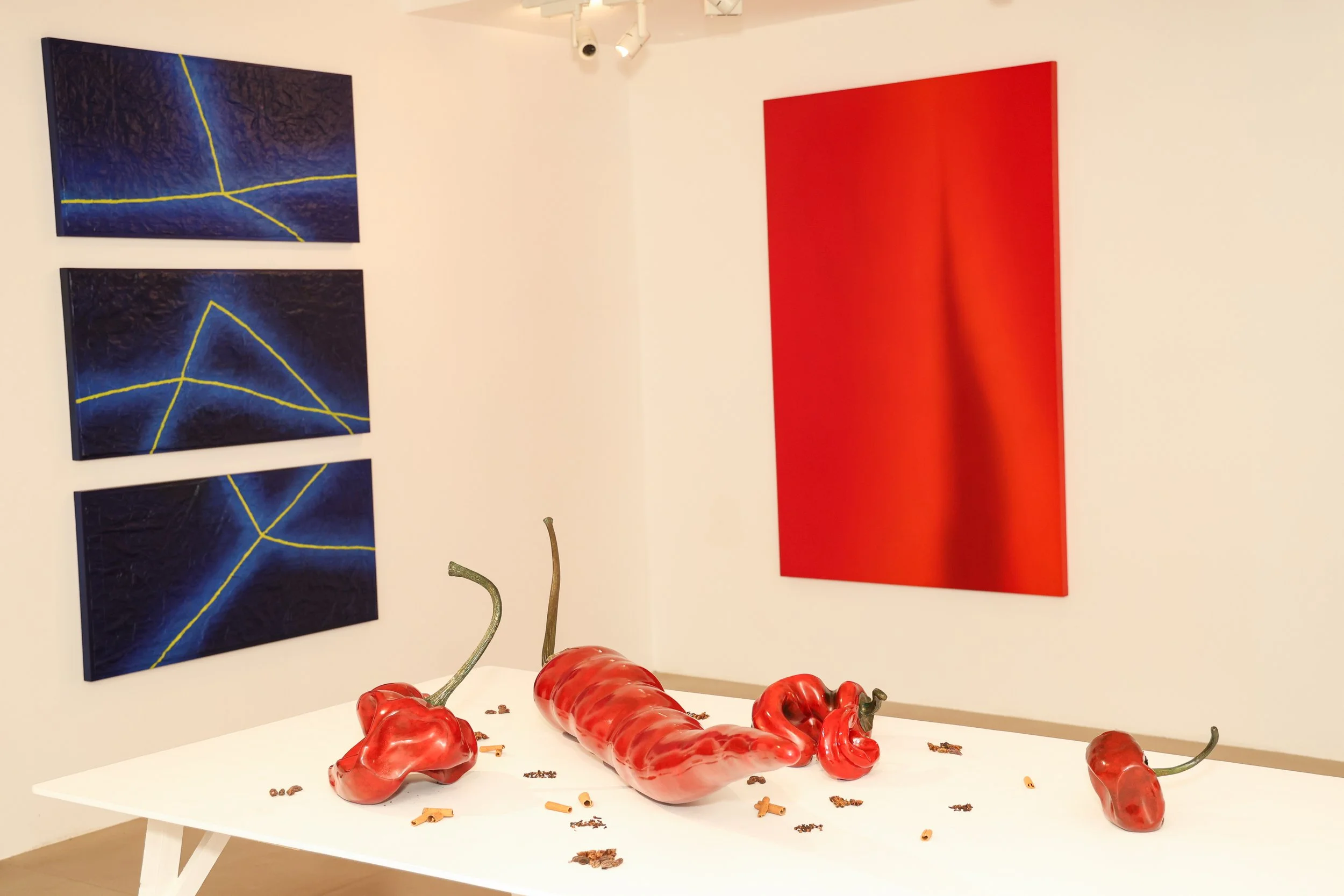
This exhibition gathers works spanning three decades of my practice, bringing together pieces like Monument (reimagined from 1996) and Tango (2024). As you move through the space, I invite you to notice how threads of cultural exchange, migration, and transformation weave through the works, reflecting on the cyclical nature of existence. Look closely at the materials, humble yet potent: saga seeds, chili peppers, nutmegs. They hold within them infinite potential, becoming bridges between the tangible and the mystical. Engage with the sensorial layers of the experience: the textures beneath your fingertips, the weight of forms, even the traces of scent. These are not just objects to view but presences to encounter. Most of all, allow the colours to guide you. Watch how they shift between cultural specificity and universal resonance, opening a space for meditation on perception, memory, and transcendence. This is an invitation not just to see, but to feel, to sense, and to reflect.
3. How did/does India inform your art? As the land of your ancestors, in what ways does it shape your art?
India shapes my art through the cultural memories embedded in colours, forms, fragrances, and textures. The scarlet hue that runs through my work carries deep significance - it's the colour of hibiscus flowers I collected for our family altar, the bindi, wedding ceremonies, and Shakti, the divine feminine force. Growing up immersed in these traditions rooted in nature, I was surrounded by sounds, aromas, and rituals that left profound impressions. My work is deeply rooted in Hindu cosmology, where celestial bodies dictate hues and chromatic frequencies chart the energies of the universe. India provides the spiritual and cultural foundation from which my universal language emerges.
4. As a conceptual artist, what inspires you most in your depictions?
I'm most inspired by making the abstract tangible - transforming fleeting experiences into form, colour, and movement that others can encounter and feel. The idea of rituals as art particularly inspires me, understanding their impermanence while celebrating their profound impact. I'm drawn to celebrating the vitality, rhythm, and energy of life as it unfolds in each precious moment - the eternal NOW. The potential energy and mystery held within natural elements, the way cultural memory travels across borders like spice aromas, and how individual narratives rooted in heritage can speak universally - these intersections fuel my creative vision.
5. In a modernising world, why is the attention on ancient spice routes still important?
The spice routes represent something timeless about human connection and cultural exchange. In our fast-paced, globalizing world, they remind us that cultural fluidity and exchange have always been part of human experience. These ancient pathways show how traditions can flow across borders, adapting and enriching each place they touch while maintaining their essential character. They demonstrate that we can honour our origins while remaining open to transformation. In contemporary cities, this understanding becomes crucial for creating inclusive spaces where multiple cultures can coexist and enrich each other, just as I experienced growing up in multicultural Malaysia and Singapore.
6. Why has the depiction of seeds been so central to your work?
Seeds embody infinite potential - they're nature's perfect metaphor for transformation and continuity. They represent the ultimate play with elements, holding potential energy, mystery, and the unknown within their small forms. Seeds carry memory while holding promise, representing the cyclical nature of existence central to my heritage. They bridge the tangible and mystical, rooted in earth yet reaching toward transcendence. In works like my Saga Seed installation at Changi Airport and ANAHATA with its 4,000 kilograms of scarlet saga seeds, they become universal connectors - bringing cultures together through shared symbolism of growth and potential while allowing each tradition to maintain its unique voice.
7. Your art is in public spaces. How does that alter the way it is perceived?
Monumental scale transforms art from object to environment, from viewing to experiencing. In public spaces, I create "doorways to experience" where viewers become participants, each bringing their own story to the collective experience. Public art serves as a bridge between the everyday and transcendent, creating moments of connection in fast-paced urban environments. It becomes a universal language speaking across cultural boundaries while celebrating local traditions. The approach requires considering how many senses to engage - children naturally touch and explore while adults bring layers of interpretation. Each installation becomes bound by colour, space, and time, inviting discovery and personal connection.
8. How does public art impact the quality of life in contemporary cities?
Public art creates spaces where people can slow down and truly see, where visuals can be absorbed contemplatively. It provides moments of transcendence in everyday urban environments, offering bridges between different communities and cultures. My installations become environments where abstract concepts become tangible experiences, allowing diverse audiences to find personal meaning. Public art serves as cultural landmarks that help define a city's identity while creating shared spaces for reflection and connection. It democratizes art, making it accessible to everyone regardless of background, and creates opportunities for cross-cultural dialogue in our increasingly diverse urban spaces.
9. What does the creative process look like for you?
As an artist, I let my journey unfold naturally, each step leading to a new discovery. My process begins with essential questions: How many senses do I want to engage? What story am I sharing? Sometimes inspiration comes from the scarlet thread that weaves through my work, sometimes from materials like saga seeds, or memories of hibiscus flowers from our family altar. I embrace the freedom to explore beyond traditional boundaries every medium has its own voice, and I choose the ones that bring the experience to life. The environment becomes a creative partner, revealing new possibilities along the way. Each piece is born from the meeting point of heritage and the present moment, celebrating cultural memory while welcoming transformation.